Click on the Edit Content button to edit/add the content.
What Is the Legal Document Size in India? A Complete Guide
Introduction
Which paper dimensions should you choose when printing official legal papers? Choosing the right paper is important when preparing property records, agreements, office files, and other official papers. The correct size helps keep information organised, readable, and easy to handle.
The term legal document size usually refers to the dimensions of paper used to prepare or print legal documents. However, there is no single paper size that applies to every legal document in India. The required format may depend on the document type, the concerned authority, and the purpose for which the paper is being used.
This guide explains common paper sizes, their uses, the difference between legal-size and A4 paper, and how to choose the appropriate format for your documents in India.
What Is Legal Document Size?
Legal document size describes the dimensions of a sheet of paper used for legal or official paperwork. Different countries follow different paper standards, so the meaning of legal-size paper can vary depending on the location.
In India, A4 paper is widely used for general office documents, printed agreements, applications, and many other records. Some legal and administrative documents may require a different format based on specific instructions.
For this reason, it is always advisable to check the paper requirements before printing or submitting an important document.
Which Paper Dimensions Are Commonly Used for Legal Papers in India?
In countries such as the United States, the commonly recognised legal paper size measures 8.5 × 14 inches, which is approximately 216 × 356 millimetres. This paper format offers more length than the commonly used US Letter sheet.
However, this American legal paper measurement should not automatically be treated as the standard for every legal document in India. Indian organisations and authorities may follow different paper specifications according to their requirements.
Which Paper Size Is Commonly Used for Legal Documents in India?
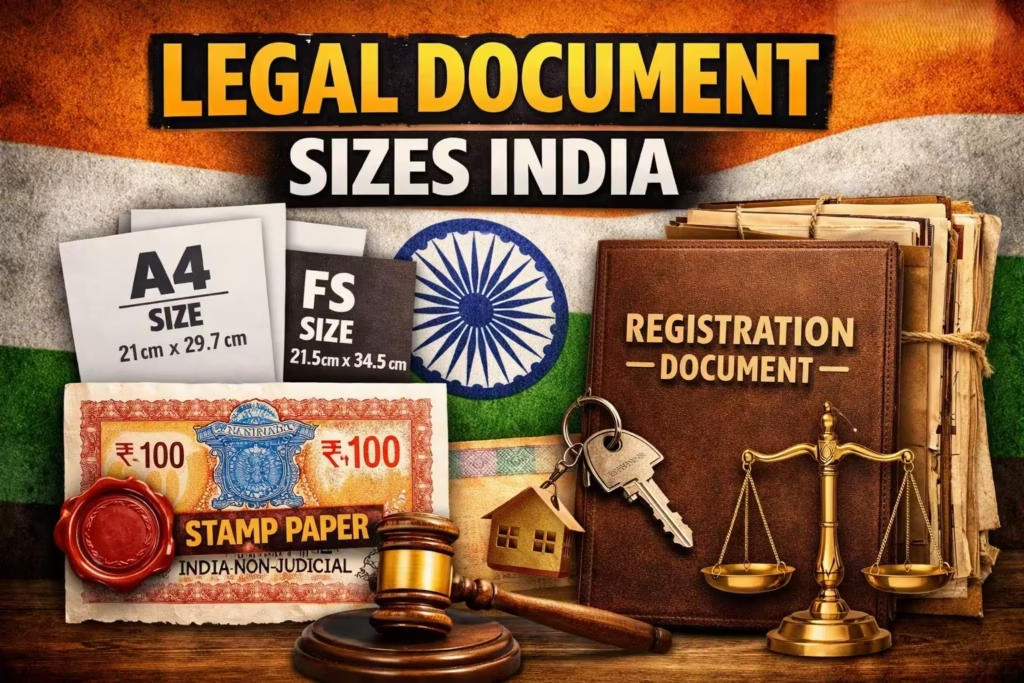
India commonly follows the ISO A-series paper system for everyday printing and office work. Among these formats, A4 is one of the most widely used options.
An A4 sheet has a width of 210 mm and a length of 297 mm, equivalent to around 8.27 × 11.69 inches.
A4 paper is suitable for many purposes, including:
Preparing office letters and reports.
Printing property-related information.
Creating agreements and supporting documents.
Maintaining business records.
Preparing applications and formal correspondence.
Printing invoices and other administrative papers.
Some legal documents may require stamp paper, non-judicial stamp paper, prescribed forms, or other specific formats. Their requirements should be checked separately rather than relying only on ordinary paper dimensions.
What Is the Difference Between Legal-Size Paper and A4 Paper?
dia commonly follows the ISO A-series paper system for everyday printing and office work. Among these formats, A4 is one of the most widely used options.
An A4 sheet has a width of 210 mm and a length of 297 mm, equivalent to around 8.27 × 11.69 inches.
A4 paper is suitable for many purposes, including:
Preparing office letters and reports.
Printing property-related information.
Creating agreements and supporting documents.
Maintaining business records.
Preparing applications and formal correspondence.
Printing invoices and other administrative papers.
Some legal documents may require stamp paper, non-judicial stamp paper, prescribed forms, or other specific formats. Their requirements should be checked separately rather than relying only on ordinary paper dimensions.
Legal-size paper and A4 paper differ in their dimensions and common applications.
Legal-size paper, as used in the United States, measures 216 × 356 mm. The dimensions of an A4 sheet are 210 mm by 297 mm.
The most noticeable difference is the length. Legal-size paper is considerably longer, providing more room for text on a single page. A4 paper is shorter and is commonly used for routine printing in Indian offices and institutions.
Selecting the correct paper format helps prevent avoidable problems during printing, filing, and submission.
1. Improves readability
A suitable page size allows text, headings, signatures, and other information to appear clearly. Proper formatting makes the document easier to review.
2. Prevents printing errors
Using an incorrect paper setting may cause text to move outside the margins, become smaller than expected, or continue onto additional pages.
3. Supports document organisation
Consistent paper dimensions make it easier to arrange files, store records, and maintain office paperwork.
4. Helps meet submission requirements
Certain institutions may prescribe a particular format. Following their instructions can reduce the risk of rejection or requests for correction.
5. Protects important information
Appropriate page settings help ensure that names, dates, clauses, and other details are printed completely.
What Types of Documents May Require Special Paper Formats?
Not every legal document follows the same printing requirements. The appropriate format depends on the document and the rules applicable to it.
Property Documents
Property transactions may involve sale agreements, conveyance deeds, supporting records, and other paperwork. The required format can depend on the document and the registration process.
Rental and Lease Agreements
Rental agreements contain information about the property, rent, deposit, duration, and responsibilities of the parties. The parties should verify applicable stamp duty and execution requirements in addition to checking the printing format.
Affidavits and Declarations
Affidavits and declarations may need to follow prescribed formats or be executed on appropriate stamp paper, where applicable. Requirements should be confirmed with the relevant authority or legal professional.
Business Agreements
Commercial agreements, partnership documents, and service contracts are commonly prepared using standard office paper. However, the parties should follow any specific format or execution instructions that apply.
Court-Related Documents
Court filings and related paperwork may be subject to particular procedural rules, prescribed forms, and filing requirements. The relevant court’s current instructions should always take priority over general printing advice.
How Can You Select the Correct Paper Size for Legal Documents?
Choosing a suitable format becomes easier when you follow a few simple steps.
Step 1: Identify the document type
First, identify the document you need to prepare, whether it is a contract, property-related record, sworn statement, formal application, or other official paper.
Step 2: Check the instructions
Review the requirements provided by the relevant court, registration office, institution, or organisation.
Step 3: Confirm the paper dimensions
Check whether the instructions specify A4, a particular legal-size format, stamp paper, or another prescribed form.
Step 4: Adjust the printing settings
Select the correct paper size in your word processor or printer settings. Check the page orientation and margins before printing.
Step 5: Preview the document
Review the print preview to confirm that the text, tables, signatures, and other details fit correctly on the page.
Step 6: Verify the final copy
After printing, ensure that all pages are complete, properly arranged, and readable.
What Are Common Mistakes to Avoid?
People sometimes assume that every legal document must be printed on US legal-size paper. This is not a universal rule, particularly in India.
Other common mistakes include selecting the wrong paper setting, using unsuitable margins, printing without checking the final preview, and overlooking instructions from the concerned authority.
Another important point is that paper size and legal validity are different matters. Printing a document on the correct paper does not automatically make it legally valid. Applicable requirements relating to signatures, stamp duty, registration, witnesses, and execution must also be followed wherever necessary.
The commonly recognised US legal paper size is 8.5 × 14 inches. However, the required size for a legal document in India depends on the document and the relevant instructions.
2. Is A4 paper suitable for legal documents in India?
A4 paper is widely used for official paperwork in India. It can be suitable for many legal documents, provided the relevant authority or applicable rules do not require another format.
3. Is legal-size paper bigger than A4?
Yes. US legal-size paper is longer than A4 paper and slightly wider. The difference is mainly noticeable in the height of the page.
4. Do property documents require legal-size paper?
Not necessarily. Property documents may have different paper, stamp duty, execution, and registration requirements. Always confirm the applicable rules before preparing the final document.
5. Can I print a legal document on ordinary paper?
Some documents can be printed on ordinary paper, while others may require prescribed forms, stamp paper, or specific execution procedures. The document type and applicable rules determine what is acceptable.
Conclusion
Understanding legal document size helps individuals, businesses, and property professionals prepare their paperwork more carefully. Although US legal-size paper measures 8.5 × 14 inches, A4 paper is widely used for everyday official printing in India.
The most appropriate format depends on the purpose of the document and the requirements of the relevant authority. Before printing or submitting an important record, verify the specified dimensions and any additional legal formalities.
By choosing the correct paper format, checking printer settings, and reviewing every page, you can keep your documents neat, readable, and properly organised.