Click on the Edit Content button to edit/add the content.
Does Real Estate Have a Full Form? Meaning, Types, Uses and Career Option
Introduction
Have you ever thought about buying a house, renting a flat, or selling a piece of land? During your search, you may have noticed the term “real estate.” It is widely used in property advertisements, construction businesses, and investment discussions. Many people search for the real estate full form because they want to know what the term means.
The real estate sector plays a major role in India’s economic growth. Families buy houses for their living needs, businesses use commercial buildings for their activities, and investors purchase properties to earn rental income. The industry also provides employment in sales, marketing, property management, and consultancy. This article explains the meaning of real estate, its major categories, its role in India, and the skills needed to build a career in this industry.
Real estate does not have a full form because it is not an abbreviation. The term describes land and permanent structures built on it, including houses, apartments, offices, and shops. Simply put, real estate means land and any buildings or structures attached to it.
Land and buildings are different from movable items such as cars, computers, and furniture. For example, a person who owns a plot in Chennai or a flat in Coimbatore owns real estate. A shop owner who owns a commercial building also holds real estate. Therefore, the correct explanation is that real estate is a complete term rather than a shortened form of other words.
What Does Real Estate Mean?
Real estate covers land and buildings that are permanently attached to it. These properties may be used for living, business, industrial activities, farming, or investment.
Common examples are:
Houses and apartments.
Shops and office spaces.
Factories and storage buildings.
Agricultural fields.
Residential and commercial plots.
Depending on the applicable rules, properties may be bought, sold, rented, leased, or developed.
What Are the Four Main Categories of Real Estate?
Real estate is generally divided into four major categories based on how the properties are used.
1. Residential Properties
Residential properties are buildings or homes intended for people to live in, such as houses, apartments, and flats. It includes independent houses, flats, villas, duplex homes, and residential plots. Some buyers choose these homes for their own accommodation, while others keep them to earn money by renting them out.
2. Commercial Properties
Commercial properties are places used to run businesses, such as offices, shops, shopping malls, and restaurants.
3. Industrial Real Estate
Industrial real estate covers properties used for production, manufacturing, storage, and distribution. Factories, industrial sheds, and distribution warehouses belong to this category. These spaces help companies manufacture products and transport goods to different markets.
4. Agricultural Real Estate
Agricultural real estate refers to land used for farming and related activities. This category covers farmland, crop-growing areas, and plots used for farming-related purposes. In India, agricultural land transactions and permitted uses may be affected by state-specific laws.
How Does Real Estate Work in India?
Buying or selling property includes several steps, starting with finding the right buyer or property and ending with the final deal.
Property selection: The buyer identifies a suitable house, plot, apartment, or commercial space.
Market research: The buyer compares prices, locations, transport access, and nearby facilities.
Document checking: Relevant records are reviewed to understand ownership, existing encumbrances, and required approvals.
Negotiation: The buyer and seller discuss the price and other conditions.
Agreement and registration: The parties complete the required paperwork and registration formalities according to applicable law.
Property agents can help customers shortlist suitable options, arrange on-site inspections, discuss their requirements, and stay in touch throughout the process. Buyers should also check whether a real estate project requires registration under the Real Estate (Regulation and Development) Act, 2016, known as RERA.
Real estate serves several purposes in everyday life and business.
Housing: Residential properties provide homes for individuals and families.
Business development: Offices, shops, factories, and warehouses give businesses the space they need.
Employment: The industry supports jobs for agents, engineers, architects, sales executives, construction workers, and property managers.
Investment: Some people buy properties to earn rent or benefit from possible price appreciation. However, property values can decrease, and profits are not guaranteed.
Infrastructure: Property development can contribute to the demand for roads, transport, electricity, and other facilities.
How Is Real Estate Different from Property?
Real estate means land and any buildings or structures that are permanently built on it. Property is a wider term that may also include movable belongings and other assets.
A house or apartment falls under immovable property, whereas items such as vehicles, computers, and home furnishings can generally be moved from one place to another. The exact meaning of property can depend on the legal or business context.
Who Is a Real Estate Agent?
A real estate agent helps people find suitable properties and connects buyers, sellers, landlords, or tenants.
An agent’s work may include:
Finding potential clients.
Sharing property information.
Answering customer questions.
Organising site visits.
Explaining property features.
Assisting with price discussions.
Following up with interested customers.
Coordinating with other professionals.
The responsibilities of an agent depend on the role and the applicable legal requirements.
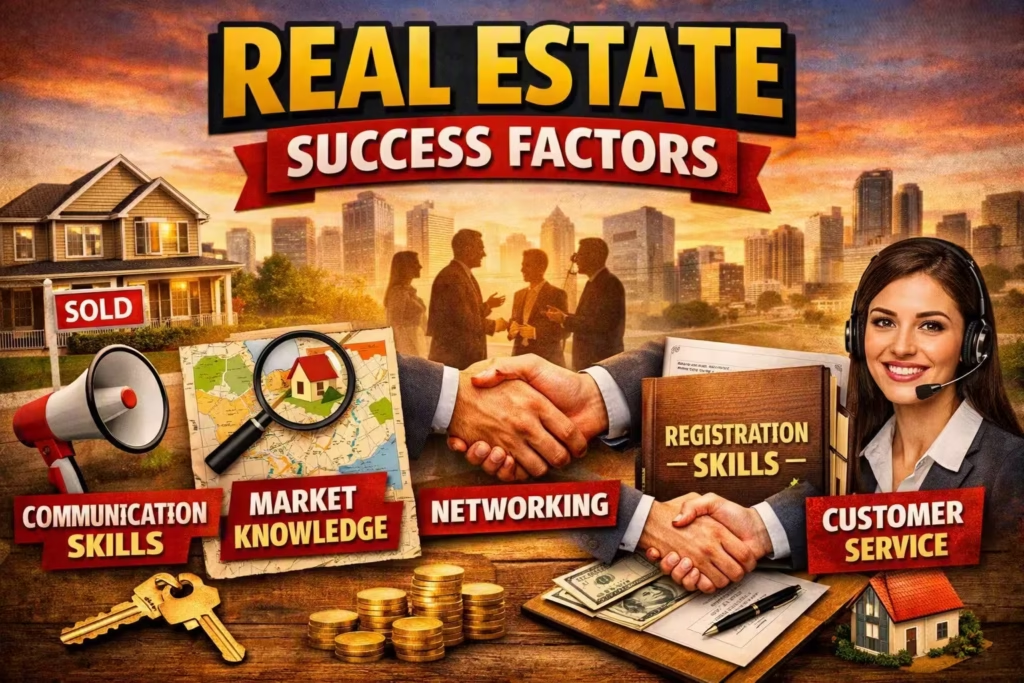
What Skills Are Useful in Real Estate?
People who want to work in real estate can develop the following skills.
Communication: Helps professionals understand client requirements and explain property details.
Lead generation: Helps identify people interested in buying, selling, or renting properties.
Follow-up: Maintains communication with potential clients and helps answer their questions.
Negotiation: Supports discussions about prices, payment terms, and other conditions.
Property knowledge: Includes understanding property categories, locations, pricing factors, and basic documentation.
Digital marketing: Uses search engines, social media, online advertisements, and property platforms to reach potential customers.
Documentation awareness: Helps professionals recognise important records and understand when legal guidance is necessary.
How Can a Beginner Enter the Real Estate Industry?
A beginner can take the following steps to explore this career.
Learn the basics: Understand property types, common terms, and the usual stages of a transaction.
Develop selling abilities: Build confidence in speaking with customers, discussing property deals, and understanding buyers’ needs.
Study property records: Learn why ownership documents, approvals, and legal checks matter.
Gain practical experience: Seek supervised work or training with an established property business.
Understand online promotion: Learn how to advertise properties accurately through digital platforms.
Check professional requirements: Understand the rules that apply to the role before starting work.
Regular practice and hands-on learning help newcomers gain confidence and improve their skills in the real estate industry.
No. Real estate is not an abbreviation. It is a term used for land and permanent structures such as houses, shops, and offices.
2. What is real estate in simple language?
Real estate means land and buildings connected to it. A house, apartment, commercial shop, or agricultural plot can be an example.
3. Is real estate an acronym?
No, “real estate” is a complete phrase used to describe land and buildings, rather than an abbreviation that needs to be expanded.
4. What are the four categories of real estate?
The four common categories are residential, commercial, industrial, and agricultural real estate.
5. What is real estate called in India?
It is commonly called property or immovable property, depending on the context and applicable legal definition.
6. Can a fresher get a real estate job?
Yes. Freshers may explore property sales, lead generation, customer support, marketing, and property management roles. Requirements vary by employer and position.
7. Is real estate a suitable career?
It can suit people interested in sales, communication, networking, and property-related work. Earnings and growth depend on experience, market conditions, and job responsibilities.
8. What is the full form of RERA?
RERA refers to the Real Estate (Regulation and Development) Act, 2016, an Indian law intended to improve transparency and accountability in the real estate sector.
9. What does a real estate business do?
Real estate businesses can focus on buying and selling properties, renting spaces, leasing buildings, developing land, or managing properties for clients.
10. How can I learn real estate sales?
Start with property fundamentals, customer communication, lead generation, site visits, negotiation, and follow-up techniques. Practical training can help you apply what you learn.
Conclusion
Real estate is not an abbreviation, so it does not have a full form. It refers to land and permanent structures, including residential houses, commercial shops, offices, and industrial buildings. The industry provides opportunities in sales, marketing, consultancy, and property management. Beginners can prepare for these roles by learning property basics, developing communication skills, and understanding the importance of proper documentation.